Showing posts with label water. Show all posts

Friday, August 24, 2007

Victory for Lake Michigan!

I'm astounded--BP made a public announcement stating they will not increase their dumping of ammonia and sludge into Lake Michigan. Rebecca Stanfield, Director of Environment Illinois, sent this email to everyone who signed the Save-the-Lake petition:

"Citing 'ongoing regional opposition,' BP America Chairman and President Bob Malone announced this morning that the company will avoid any increased pollution into Lake Michigan from its oil refinery in Whiting, Indiana. BP has heard the voices of hundreds of thousands of Great Lakes region residents saying that Lake Michigan is a natural treasure and source of drinking water, not our dumping ground. In response, BP has issued a non-binding statement indicating it will avoid increased dumping of ammonia and toxics-containing solids, which are allowed by its new discharge permit issued in June by Indiana's Department of Environmental Management."

This victory is due in part, to over 100,000 people voicing their opposition and working together to overturn this permit. Wow, what a great success story!! This is a clear example of how individuals can band together to make a positive difference in their community.

But the battle is not quite over. Because this is a non-binding agreement, BP may be playing lip service to quell the public outcry, perhaps waiting for the opposition to diminish and forget this issue. And once forgotton, BP may quietly increase their dumping of pollutants into Lake Michigan--and they'll get away with it because that permit has not been amended.

So let's make sure BP will stand by their word! Rebecca Stanfield would like for you to send a message to BP asking them to obtain an amended permit that will prevent any increase in pollution into Lake Michigan. Click here to send your message to BP.

Wednesday, August 15, 2007

Dear BP: It's Not OK to Pollute Lake Michigan

The fight against BP is not yet over: Congress is trying to pass legislation to reverse the EPA's decision of allowing BP to dump more toxic waste into Lake Michigan.


Today's Chicago Tribune also features a great story on the EPA's response to the public's outcry against polluting the lake. I'm not sure if the public will accept the EPA's seven alternative suggestions. I think folks just want BP to stop polluting Lake Michigan!

Monday, August 06, 2007

Environment Illinois

I'm not sure if this will have any effect on the EPA's recent decision to allow BP to dump toxins into Lake Michigan, but I just signed another online petition to stop polluting the lake. If you're interested in letting BP's CEO Tony Hayward and the EPA's Regional Adminstrator Mary Gade know your concern against further dumping of water pollutants into Lake Michigan, please click here to sign the petition.

Tuesday, July 31, 2007

Chicagoans Wake-Up to Lake Michigan Pollution

Good news! More than 45,000 people have signed petitions, including the Save the Lake Petition, to stop the BP oil refinery from dumping more ammonia and sludge into Lake Michigan. And thank goodness, this issue has been featured in today's New York Times, so if you have a moment, I encourage you to read it. I first heard about this issue in May; I was astonished to discover that BP wants to dump 1,584 pounds of ammonia and up to 4,925 pounds of sludge everyday. What effects does this dumping have on plants and animals in Lake Michigan? And what effects does this dumping have on children and adults swimming in the lake?

And here's another question: What are the implications for stopping an increase in dumping pollutants into Lake Michigan? I'm guessing that the cost of gasoline will be affected if this permit is not granted. If this permit doesn't get passed, then maybe we'll have to pay even more money for gas. Imagine this: Would you be willing to pay $5/gallon for gasoline?

If I had to pay $5/gallon for gas, then it would alter my driving habits considerably. I already bike to work; well, my biking behavior would definitely increase. I would also think twice before hopping into car...I would ask myself if I really needed to drive to that destination and I would consider alternatives to driving to those locations. Maybe I would take the train to Chicago, as opposed to riding the bus. I would certainly drive less than I do now...no going to Saugatuck, which I'm driving to tomorrow!

Sure, I'm entertaining these questions now, but these questions would carry much more weight if the cost of gas were substantially raised. The gas issue also reminds me of Europeans, who are already accustomed to paying more for gas. So maybe it's about time we address how these issues (and implications) will affect our lifestyle behaviors.

Monday, July 23, 2007

Help Save the Lake!

Julie left a comment about her recent experience visiting the Indiana Dunes. Reading her comment inspired me to get an update about BP's efforts to dump ammonia and sludge into Lake Michigan.

On Saturday, there was a press conference in Whiting, IN, where one of BP's oil refineries is located. Both Senator Dick Durbin and House Representative Rahm Emanuel have joined the campaign to protest against dumping more wastewater into Lake Michigan.

I'm so glad to hear this news; we need to have this level of support against a giant company like BP.

In addition, the Chicago Park District is asking folks to sign the "Save the Lake" petition. Wanting to sign this petition, but noticing there's not an online method to do so, I called Janis Taylor of the Chicago Park District. Janis told me it's ok to print the pdf file, sign my name, and fax it over to her. If you feel compelled to keep Lake Michigan clean, I encourage you to sign and fax this petition, too.

Saturday, July 14, 2007

What Does "Treated Wastewater" Really Mean?

In a recent comment about dumping more garbage into Lake Michigan, Anonymous posted a link to a document published by the Indiana Department of Environmental Management (IDEM). I started reading this 52-page document tonight; I'm struck by the level of detail that's contained in this document. For example, I read that it's permissible to discharge up to 2,600 lbs of oil and grease into Lake Michigan everyday. And the list includes the discharge rates of other chemicals and metals, including mercury, ammonia, chromium, chlorine, and phosphorus.

I'm a psychologist, clearly not a chemist, ecologist, nor a biologist, so perhaps these are silly questions to ask, but what does "treated wastewater" really mean?? How is this waste neutralized and how rigorous are these tests that measure treated wastewater? How often does IDEM evaluate the content of treated wastewater? Does treated wastewater have any deleterious effects on plants and animals?

I'm definitely going to read this document carefully; hopefully, I'll gain greater insight into this wastewater issue. If you have a moment to peruse this document, please feel free to share your thoughts on the matter. Oh, and any information you're able to send my way concerning what the heck "treated wastewater" really means is much appreciated. And thanks, Anonymous, for posting this document on the blog!! :0)

Monday, June 11, 2007

Drinking Water...28 Billion Bottles Each Year


On today's Morning Edition, I heard a story about the increased demand to recycle water bottles. Turns out, most folks trash their used water bottles. If US recycling facilities have it their way, however, more bottle bills will be passed to increase the recycling rate of water bottles. (The current recycling rate for water & soda bottles is 23%.)

From an environmental perspective, passing a bottle bill sounds like a great idea. It simply doesn't make much sense to toss precious resources into landfills. After all, water bottles are made from polyethylene terephthalate (i.e., crude oil and natural gas), which are non-renewable resources.

But don't forget about economics: Recyclers will make tons of money from selling old water bottles to businesses. According to the Container Recycling Institute, Americans consume approximately 28 billion single-serve water bottles each year. How much money will businesses profit from recycling used water bottles? China knows the answer to this question. They're the #1 importers of this product.

All this talk about recycling, however, ignores the other two R's: reduce and reuse. We can sidestep this issue dramatically by using reusable water bottles.

Since hearing Elizabeth Royte's featured speech at BagFest, I made the switch from using plastic bottles to this ultra-cool reusable bottle made from aluminum. It really was just a minor tweak in my drinking behavior. If you're interested in making the water-bottle switch, check out this website: www.reusablebags.com

Saturday, June 09, 2007

Beauty (and the Beast) at the Indiana Dunes

Today, Dawn and I took our puppies to the Indiana Dunes, which is located along Lake Michigan. Our mission: To give the pups plenty of exercise so that they would be conked out by the time we returned home. And mission accomplished! The pups are now peacefully napping. :0)

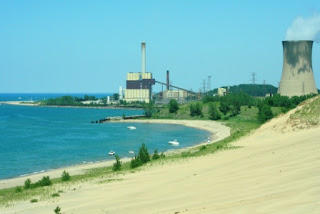
Not knowing what to expect, we brought our cameras to take a few photographs. After climbing the summit of one of the dunes, we saw this incredible view:


Isn't Lake Michigan beautiful? My face immediately fell, however, when I turned my gaze to the right. Here's what I saw next:


Not a pretty sight. And I was really hoping to take my mind off these sort of issues. Well, not wanting to feel jaded, Dawn and I took the pups to the shore and then trekked along the trails. And we had a blast!

Here's a pic of Dawn with her pup, Lucy:


And here are my two critters, Jack and Willy:

So despite seeing the beastly refinery, we all enjoyed our Saturday outing to the Indiana Dunes. :0)

Thursday, May 10, 2007

Two Gifts for Lake Michigan: Ammonia & Sludge

In case you missed the news, BP oil wants to expand their oil refinery in Whiting, IN in order to handle Canadian crude oil. Consequently, they're seeking permits to increase the amount of waste they dump into Lake Michigan.

BP oil currently dumps 21.4 million gallons of treated wastewater each day.

Now BP wants to add 50% more ammonia and 35% more sludge (i.e., solid waste) into their wastewater each day.

Is there anything we can do about this proposal? There's not much time, but we can act now. (Actually, we have until Friday to voice our concern.) IDEM will consider all written comments before making a final decision about BP's draft wastewater permit. You can send your comment by mailing, e-mailing or faxing them to:

Indiana Department of Environmental Management
Office of Water Quality
MC 65-42SR IGCN-1255
100 N. Senate Ave.
Indianapolis, IN 46204-2251

Fax: (317) 232-8637
E-mail: sroush@idem.in.gov

Wednesday, April 25, 2007

Goodbye Plastic Bottle, Hello SIGG


As part of the requirements for my college degree, I had to enroll in a course on health & fitness. I was shocked to learn that adults should drink 3 liters of water daily. That's basically a gallon of water every day. My jaw dropped in astonishment.

Oh my Lord, I thought. If I drink 3L of water everyday, I'm going to spend most of my day in the bathroom. Good grief.

But, I reasoned, this is good for my health. So I decided to drink more water, that is, 3L of water each day. And yes, I spent more quality time in the bathroom! But my body adapted to this change, and now, it's a daily habit. My body actually feels deprived whenever I don't drink my usual 3L of water.

Anyway, my jaw recently dropped on another occassion. This time, it was at BagFest. I was gleefully following along to Elizabeth Royte's talk, when suddenly she raised a plastic bottle to make a point about the dangers of plastics. Now, this was no ordinary plastic bottle: It was MY plastic bottle she was publicly condemning! Oh, for the love...how I embrace public shame is beyond me. I think I actually cowered when I saw that bottle raised in contempt.

But point well taken. As I recently learned, disposing plastic bottles is a dirty business. Toxins and dioxins are released when incinerated, so torching them is out of the question. In landfills, plastics can last for thousands of years, leaching toxins as they disintegrate. (Ok, that's not a good solution.) And recycling plastics creates poorer-quality plastics. (Great, we're three for three here. Folks, that's a strike-out!)

As Tony asked, "What on Earth are we to do?"

For me, the answer was simple: Stop using plastic bottles. So now I'm the happy owner of this SIGG bottle. It's a 1L bottle made from aluminum, which I purchased from www.reusablebags.com. I also got a 1/2 L SIGG bottle for easy travel.

So, goodbye plastic water bottle. Hello SIGG! :0)

Tuesday, April 24, 2007

Water Issues

First off, I would like to admit that I have been a little negligent about actually checking the blog, but boy, look what I was missing! I am a bit of a novice when it comes to blogging (case in point: this is really my first, err, second time), so I hope that you all will forgive me. After perusing the various postings I was astounded by the revealings of my peers, and I have come to the realization that this particular blog is quite resourceful; when it comes to environmental issues, consider me sold.

Recently, I had the opportunity to submit a research paper regarding the issue of water diversions out of the Great Lakes basin. It seems that as denizens of this region, not many people (myself included), were really inlcined to know much about the Lakes, so I decided to do a little bit of investigating. After reviewing some scientific literature, the inferences that I was able to procure were quite alarming. In lieu of trying to summarize all of my findings, I would definitely encourage you to do a little bit of surfing around. A great website for learning more about diversions and the immense capabilites that the Great Lakes system provides is available at the following:

http://www.glwi.uwm.edu/ourwaters/

The information was compiled by the Great Lakes Water Institute and I found it to be very insightful.

To tie this all back to Royte and sustainability, one very interesting fact that I was able to glean from my research deals with bottled water. Due to the seemingly vast amount of fresh water right next door and looming concerns over the issues related to water scarcity, some proponents of diversions see it as an opportunity to exploit the water and sell it as a commodity; even ship it overseas. Fortunately, there is some legislation to protect this from happening, but loop-holes do indeed exist.

According to some information from the GLWI website, "The 2005 Annex Implementing Agreements regulate new diversions and exports of water out of the basin in pipelines, canals, and containers larger than 5.7 gallons." Current legislation does not, however, contain a mandate on shipping water out of the basin in smaller containers, and the implications of such could be disastrous for our region. What we're talking about is the complete loss of habitat as the lake levels decline. This could ,in turn, play host to a number of malignant scenarios, any of which we would not wish to come to fruition.

To make matters worse, the U.S. alone has witnessed a marked rise in the consumption of bottled water. The GLWI provides that, "Americans drank 6.8 billion gallons of bottled water in 2004, compared to 15.3 billion gallons of soda. The Beverage Marketing Corps. predicts that bottled water will soon be Americans 2nd most popular beverage (soft drinks rank 1st)." The fact that the water is "bottled" only confounds our current plastic footprint. What on Earth are we to do?